
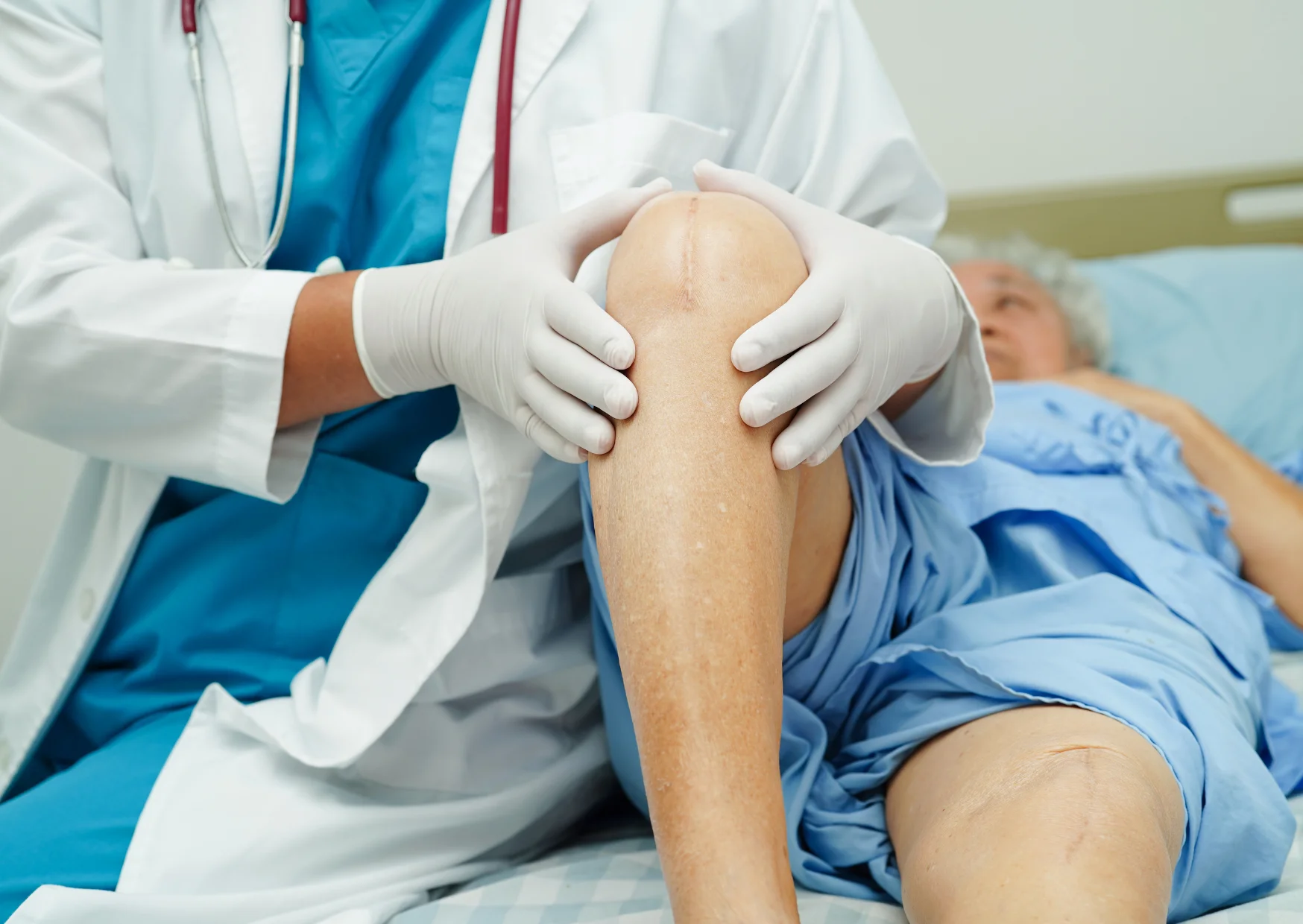
A new knee replacement changes almost every part of daily life for a few months, from how you sleep to how you climb stairs. The recovery timeline follows a fairly predictable arc, but the week-by-week reality rarely matches what people picture before surgery. Knowing what your body is doing at each stage makes the whole process a lot less overwhelming. So does knowing why staying consistent with early rehab pays off later.
Quick Answer: Knee Replacement Recovery Timeline
Most patients move through three phases: intensive in-clinic PT for the first six weeks, tapering outpatient sessions through week twelve, and independent strengthening from month three onward. Swelling and stiffness peak around week two or three before steadily easing, while full quad strength often takes six to twelve months to return. Expect progress that isn’t a straight line: good days and frustrating ones both belong in a normal recovery.
Weeks 1-2: The First Days After Surgery
Therapy typically starts within 24 hours of surgery, often while you’re still in the hospital. Sessions in these first two weeks focus on three things:
- Getting in and out of bed, a chair, and the car safely
- Walking short distances with a walker or cane
- Basic bending and straightening exercises to prevent the knee from stiffening
Swelling is heaviest here, and pain tends to spike in the evenings. Ice, elevation, and your prescribed home exercises matter as much as the clinic visits themselves. Most patients reach 90 degrees of bend by the end of week two, a benchmark PTs watch closely because it’s the minimum needed for basic daily tasks like getting into a car.
Weeks 3-6: Swelling Peaks, Then Range of Motion Takes Over
This stretch is where a lot of patients get discouraged. Swelling can actually look worse before it improves, and fatigue from the surgery itself is still lingering. But it’s also when range of motion gains accelerate fastest, often reaching 110 to 120 degrees of flexion by week six.
Most protocols also increase your session frequency during recovery here, calling for two to three visits a week paired with daily home exercises. Skipping sessions during weeks three through six is one of the more common reasons patients plateau early and lose ground they have to work to regain later. Home exercises fill the gaps between visits, and patients who log them consistently tend to hit their six-week range of motion targets sooner than those who treat clinic time as the only workout that counts.
Weeks 7-12: Outpatient Therapy and Rebuilding Stability
By week seven, the focus shifts from regaining motion to rebuilding confidence in the knee’s stability. Balance work, single-leg strengthening, and stair training take over. Your therapist will also screen the knee for broader stability issues, the same kind of assessment used for posterolateral corner ligament injuries, a common knee-stability injury, in more complex cases, to make sure nothing besides the implant itself is holding you back. This is also the stage where most patients drop their walker or cane for good, though returning to driving still depends on which knee was replaced and how quickly reaction time and brake control come back.
Watch for Pain Showing Up Elsewhere
A stiff, guarded knee changes how you walk, and an altered gait puts extra load on your hips and spine. It’s common for post-op patients to develop new back pain as a result, and if that happens, it helps to know typical back pain therapy timelines so you’re not blindsided by a second recovery clock.
What Most Guides Miss: Quad Strength Lags Behind Range of Motion
Most recovery timelines focus on bend and straighten numbers because they’re easy to measure. What they leave out: quadriceps strength recovers on a much slower curve than range of motion, and research published in the Journal of Orthopaedic & Sports Physical Therapy has documented quad strength deficits that can persist a year or more after surgery when strengthening isn’t prioritized early.
In practice, that means a knee that looks “recovered” on a goniometer (the tool PTs use to measure how far a joint bends), bending and straightening fully, can still be functionally weak. Patients who feel their knee “give way” on stairs or uneven ground months after surgery are almost always dealing with a strength gap, not a mechanical problem with the implant. That’s why PT protocols keep loading exercises in the program well past the point where range of motion goals are met, and why quad sets, straight leg raises, and step-downs often remain part of your home exercise routine long after the incision has healed.
Knee Replacement Recovery Timeline by Month: 3-12
By month three, most patients transition to independent or community-based exercise, checking in with PT periodically rather than weekly. Walking without a limp, managing stairs one foot per step, and returning to light recreational activity are typical month-three markers.
Full recovery, meaning strength, endurance, and confidence back to a level that supports normal life, commonly takes six to twelve months. That range holds steady whether it’s a knee or a hip: our hip replacement recovery timeline follows a nearly identical arc, just shifted slightly earlier because hips tend to regain stability faster than knees.
Final Thoughts on the Knee Replacement Recovery Timeline
Recovery from a knee replacement rewards consistency more than intensity. The patients who do best aren’t the ones who push hardest in any single session. They’re the ones who show up for the boring, unglamorous work week after week. If you’re a few weeks out from surgery and progress feels slower than expected, or you’re still deciding on a surgery date and want to know what the months ahead actually look like, give us a call. We’ll walk you through exactly where you should be at each stage and build a plan around your specific knee.
Recent Comments